WEATHER IN BEIJING
Clima en Beijing


El Testamento del Paisa
Showing posts with label China. Show all posts

20 April, 2011

How to be a Hash House Harrier


Jared Romey explains the time-honored tradition of getting wasted and running places.

Over the course of the last five years, I’ve hashed with 28 packs in 11 countries. I’ve run through Muslim slums and desert oil fields in the Middle East, the four green fields of Ireland, the sugar cane fields of Barbados, the shiggy of Puerto Rico and the urban density of Port-of-Spain, Trinidad. I find Hashers to be the best people in the world. People who will go out of their way to pick you up at the airport, transport you around their town, let you sleep on their couch, run through the woods with you, and share their alcohol - Saigon Sally (aka Curtiss), PRH3

New in town? Looking to explore out-of-the-way, non-tourist places? Know where to meet fun people? The answer is the Hash. No, it’s not the drug. It’s not the food, either. And it’s mostly legal.

Somebody’s in trouble! Photo by davidclow

You usually first hear about it in whispers. “You Hash?,” someone may ask. “What’s that?” you reply. “Oh nothing. You kinda run some, but not always, and there’s definitely lot’s of beer, maybe even a bit of nudity. But only if you want. It’s really not as bad as it sounds. You should try it. It’s fun. I promise.”

Think of the Hash as kind of a social filter for great friends. It weeds out the straight-laced, responsible people. The left-over misfits are Hashers.

They may be Marines guarding the local embassy, the pilot who just landed your plane, that guy who manages your off-shore bank accounts, the CEO of a haircare company or a recent grad teaching English to locals. They may be expats or locals. Marathoners, teetotalers, pot-bellied couch potatoes, multi-lingual math geniuses, beach bums. They are all Hashers.

The Hash, more formally known as Hash House Harriers (HHH), is a self-professed “Drinking club with a running problem.” Founded before World War II, the Hash has grown into a worldwide phenomenon. This social club meets in cities throughout the world. Most meetings include some form of running or walking and alcohol, often both at the same time. There is always singing and perhaps a little debauchery.

Normally, running is straight-forward. One foot in front of the other and keep going. But this is the Hash. The catch? Nobody knows where the trail leads. It’s also possible nobody knows where the trail begins. And at times nobody even knows where the trail is. Symbols on the ground, generally made with flour, mark the trail for hashers. These symbols are explained at the beginning of the trail, during the chalk talk, given for the Virgins in the crowd.

Photo by basumus

Flour marks the dead-ends, song checks, beer checks, boob checks, the real trail and false trails. On any given trail, there is a 100% chance someone will get lost at some point. Just make sure you are not that person.

After the run/walk, there’s always the Hash circle. Punishments are assessed for the stupid stuff people do along the trail. These violations could be sex on the trail (no, not REALLY sex, just PDA), technology on trail, shortcutting and numerous other invented violations. The punishment is always the same. Get in the circle. Sing a song. Do a down-down. Repeat. Hares do down-downs, defined as singing a song and then slamming down your beverage of choice in one gulp. Virgins (new hashers) do down-downs. Front Running Bastards (FRBs) do down-downs. Really, everybody does down-downs.

Also, if you become a regular you will be named. Often, it is after you screw up or do something stupid. Most likely, it is not a flattering name. Ankles for Earrings, Passed Out Pumping, Play In My Pants (PIMP), Clitty Litter, Stick It In My Socket and Naughty Man are all Hash names that evoke a certain fear as to what devious behavior earned them these names.

Photo by espanol

For as off-the-wall as it sounds, most Hashes are well-organized groups. Each Hash is run by a Mis-Management Committee of a General Manager (GM), Religious Adviser (often the most unholy of people), Hare Raiser, Hash Cash, Beermeister and Haberdasher. The Committee organizes each event, everything from who lays the trail and runs the Hash circle, to purchasing beverages or offering merchandise for sale. Most Hashes charge a nominal fee to cover expenses, but you will recoup this in fun and friends in the first five minutes.

Find out about your local Hash ahead of time. Is it family-friendly, pet-friendly, extreme runners only or for walkers too? Each Hash is different. Some are miles of running, with a smidgen of social activity thrown in at the end. Others are social events, with a bit of a walk as an afterthought.

There are Hashes where kids are present, manners are required and drinking is kept to socially acceptable levels. And then there are Hashes where including kids would be a felony, alcohol consumption is beyond belief, and a little nudity is a given. No matter which version you choose, meeting great people is guaranteed.

From http://matadornetwork.com/nights/how-to-be-a-hash-house-harrier/


Share/Bookmark

29 March, 2011

A couple of Beijing figures


The Beijing Subway System with the proper station names translated to English.
Useless in Beijing of course.
How many hours does it take to go from Beijing to... here are right numbers.

Share/Bookmark

03 November, 2010

Beijing’s Weirdest and Wackiest Food


Beijing is famous for its strange foods. From scorpion to penis hot pot, CW taste tests it all and dares you to expand your palate. Here are fifteen palate adventures… if you dare. By City Weekend Beijing

Rabbit Head
Fear Factor: 5/5
Taste Factor: 5/5
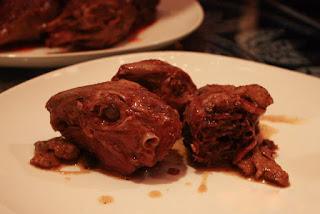
One of hundreds of delicious snacks to come out of Chengdu, rabbit head takes pride of place on the menu at Shuangliu Laoma Tutou, arguably Beijing’s best Sichuan restaurant. The heads (¥8 per head) arrive skinned, with eyes, teeth and brain intact. It is cooked in either a five-spice or mala sauce. To get the maximum amount of meat, diners separate the rabbit’s upper and lower jawbones, bite out the tongue, gnaw away the cheek meat, crack open the skull and suck out the brains, being sure to vacuum up any excess meat along the way. While those not fond of bones in their food should probably sit this one out, we found that the interesting textures of the tongue and brains complement the tasty tenderness of the flavorsome cheek meat to make a dish whose only fault is its size—each rabbit head is only as big as a tennis ball.
Find it: Shuangliu Laoma Tutou (48 Third East Ring South Road, 48号东三环南路, Tel: 6540-5858)

Silkworm Cocoon
Fear Factor: 3/5
Taste Factor: 1/5

Even when deep fried, the bulbous head of a silkworm cocoon threatens to hatch something nefarious and wiggly. We hunted down this Yunnan delicacy down at Chuan’r Bar, which specializes in skewering everything from bovine heart valves (¥3) to whole chicken heads (¥4). The silkworm chrysalis here (¥3) thankfully comes with a generous layer of cumin and chili, masking its true taste. Despite rumors of a “nutty” flavor, the spongy interior of our cocoons tasted like a shoe insole smells. More disgusting is the texture, which was very close to what a shoe insole feels like. Brave or inebriated diners can fortify themselves with the knowledge that silkworm cocoons are said to have powerful anti-aging properties. The faint of heart or sober can cheer from the sidelines with a tasty hot pot of skewers and a solid selection of veggie kebabs.
Find it: Chuan'r Bar (5–3 Dongzhimen Neidajie, 东城区东直门内大街5-3号, Tel: 6303-5678)

Fish Head
Fear Factor: 2/5
Taste Factor: 4/5
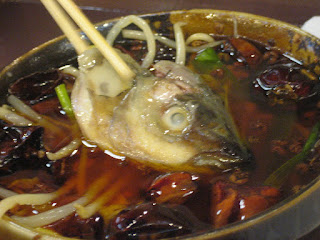
Sichuan restaurant Yu Xin serves some of the best steamed fish heads (¥58) in town. A classic Chinese dish, the steamed head of each yongyu carp is cut in half, then both halves are served cheek-side up on top of a bed of chili peppers and hot oil. The white eyes, believed to improve vision, are popular with diners and contain lots of healthy omega-3 fatty acids. Chinese diners will often fight over who gets to eat the eyes. The fish face, however, is the star of the show, as it contains the creamiest meat of the fish, the texture of which often resembles cream cheese. The small fish brain, a ball of transparent Jello-like substance connected to the eyes, has a very fishy odor and melts in the mouth. And yes, some believe it will make you smarter. Perhaps that's why in Chinese culture, the fish head should always be served so that it faces the most distinguished dinner guest.
Find it: Yu Xin (1/F, Jingtai Bldg, 24 Jianguomen Waidajie, 建国门外大街24号京泰大厦1层, Tel: 6515-6588)

Penis and Testes
Fear Factor: 5/5
Taste Factor: 1/5

According to Traditional Chinese Medicine (TCM), eating a specific animal organ will improve the health of that organ within you. If this is ever proven, Guolizhuang, aka Beijing's "penis restaurant," will become even more crowded with middle-aged men than it already is. Guolizhuang serves penis, and lots of it: dog penis, horse penis, donkey penis, ram penis, deer penis ... Snake penis is rumored to make men particularly virile as snakes have two penises, allowing copulation with two partners at once. We suggest the penis hotpot (¥988), which includes all the penises mentioned above. The hotpot broth is served with an entire turtle in it, which, according to TCM, produces longer lasting erections. The actual meat, lean and jerky like, has almost no flavor. Its presentation, however, makes it much more exciting to eat than Viagra. All seating is in private rooms, so call ahead for reservations.
Find it: Guoli Zhuang (Dongsishitiao B34-3, 东四十条乙34-3号, Tel: 6405-5698)

Weird Wines
Fear Factor: 3/5
Taste Factor: 4/5

Though China amuses tourists with snakes, animal penises and geckoes floating in bottles of everclear alcohol, only one of this nation's strange brews has a taste worthy of its oddness: Fermented mare's milk (¥45). A Mongolian alcohol made from fermenting and then distilling horse milk, the elixir tastes like a sweetened baijiu with a creamsicle aftertaste.
Though it may sound disgusting, most expats we've drunk it with have enjoyed the taste and even bought bottles of their own. We suggest picking some up at the Menggubao Chaoshi across from Little Sheep Hot Pot on Ghost Street. The Inner Mongolian foods store serves other Mongolian delights, including a range of spiced jerkies.
The fermented mare's milk is served in a yurt-shaped bottle, which also makes for a nice gift.
Find it: Caoyuan Xuri (158 Dongzhimennei Dajie, 东直门内大街158号, Tel: 8404-8518)

Spinal Chord
Fear Factor: 5/5
Taste Factor: 1/5

Ghost Street is crowded with hot pot restaurants specializing in a classic delicacy: sheep's spinal cord hot pot. One of the best is found on a small alley just east of Dongzhimennei Beixiaojie. The Huayang Jinxing Sheep Spinal Cord Hot Pot Restaurant is full of baijiu fumes and red-faced diners gorging on the dish, which is literally called "sheep scorpion" (羊蝎子) because the spinal cord looks like the poisonous insect. Anything cooked with a bone tends toward savory and hearty, and sheep spinal cord is no exception. The meat itself tasted somewhat like ribs fresh off the bone, but the texture and size of the spine itself was daunting. After you pick off the meat, bite into the spine's soft tissue and cartilage. Suck in the marrow for extra credit.
Find it: Huayang Jinxing Sheep Spinal Cord Hot Pot Restaurant (North side of Beidongxiang, east of Traktir), 东直门北小街路口北东巷内 (近北新桥派出所, Tel: 8406-0609)

Pig Brains
Fear Factor: 5/5
Taste Factor: 1/5

Kong Liang is one of Ghost Street’s most renowned hot pot restaurants, and regularly pulls in a large crowd of foreigners and Chinese, although its excellent reputation no doubt comes in spite of its pig brain dish rather than because of it. While ancient Chinese literature warns against eating brains (particularly for men), modern nutritionists claim they contains more calcium, phosphorous and iron than regular pork. Kong Liang serves a trio of raw pig brains (¥14), ready to be broiled in a mala hot pot (from ¥36) and dipped in satay sauce. Luckily, the mouth-numbing broth does a good job of covering the slightly rotten meaty taste of the brains, although it is powerless against the disagreeably squishy texture, which is likely to appeal only to fans of equally sludgy "tofu brains." There’s a saying in Chinese that says “eating brains helps the brain,” but we certainly didn’t feel any smarter after eating this.
Find it: Kongliang Chongqing Hotpot (218 Dongzhimen Neidajie, 东直门内大街218号, Tel: 8404-4906)

Scorpions and Beetles
Fear Factor: 5/5
Taste Factor: 2/5

Though crawling live scorpions and long-horned beetles will not catalyze a rush of digestive enzymes into your stomach, a good deep-frying will sedate your desire to run away. After that it’s all or nothing: close your eyes and bite in. You'll find that, thankfully, any nuance of taste has disappeared. Both scorpion and beetle tastes like a good old fashioned potato chips with a little extra grease. Perhaps your next Halloween costume can be superhero “Venom-man” with eating scorpions as a party trick? Culturally, scorpions and beetles have a long history of being ingredients in magical concoctions that treat everything from epilepsy, rheumatism, tetanus and cancer. But be wary: one vendor teased that the large scorpion variety is imported from the United States, while another reassured that they are indeed a local delicacy. Regardless, one is still left to question the medical righteousness of these bizarre skewered creatures.
Find it: Wangfujing Night Market (Just northwest of the south entrance of Wangfujing Pedestrian Street)

Pig’s Feet
Fear Factor: 2/5
Taste Factor: 3/5

A lively painting of a drooling, rabid-looking pig adorns the doorway of the “Duck Intestine Restaurant,” advertising its most popular dish: pig’s feet. Although the chef swears his trotters are cooked according to a home recipe from Yunnan, the flavors (honey roasted, hot and spicy and sour lemon sauce) bear a suspicious resemblance to pub-style chicken wings. Trotter pork is embraced by a thick blanket of fat and best eaten by biting confidently into the gelatinous flesh around the knuckles. In TCM, pig’s feet are said to beautify the skin and to help women with recovery after giving birth. We got our glow on by pairing our plate of trotters (¥36) with some braised cow feet (¥38) for virility.
Find it: Duck Intestine Restaurant (Yachang Hutong, 252 Dongzhimen Neidajie, 鸭肠胡同, 东城区东直门内大街252号, Tel: 158-1083-2956)

Ma Doufu
Fear Factor: 3/5
Taste Factor: 5/5

The first time we ate the quintessential Beijing snack ma doufu, we weren’t sure what we were digging ourselves into. It looked like chunky hummus and tasted like rotten blue cheese—but we kind of like rotten cheese. When a faint-of-heart friend nauseously told us we had ingested mashed fermented soy beans stir-fried in mutton oil topped with dried chilis, we were neither shocked nor regretful. However, when we learned that ma doufu is the filtered residue left in the creation of douzhi, an incredibly gross lao Beijing dish if you ask us, we did have second thoughts. Like most fermented foods, ma doufu is healthy, strange and polemical. Get full on a warm plate at the cozy courtyard restaurant Liu Zhai Shifu for a mere ¥15 and decide for yourself. While you’re there, take your nose to its limits with China’s answer to wasabi: jiemodun (¥8), cabbage marinated in a whole-grain mustard so potent we cried just looking at it.
Find it: Liu Zhai Shifu (Meishuguan Dong Jie, 8 Jiang Jia Dayuan Hutong, 美术馆东街, 8蒋家大院胡同, Tel: 6400-5912)

Duck Blood
Fear Factor: 3/5
Taste Factor: 5/5

Hua's Restaurant (Huajia Yiyuan) is a favorite among expats for its sublime Beijing duck and gorgeous courtyard. But those willing to explore the menu more deeply will find a few exciting, odd Chinese delicacies among the restaurant's expat-friendly Chinese classics. We recommend the maoxuewang (¥48), literally "bubbling blood," which is served in a large bowl of mala broth and a range of animal organs, including cow stomach and pig intestine. The duck blood itself is very pleasant, with a soft tofu texture and salty flavor vaguely reminiscent of black pudding, its bloody Western cousin. The small, dark, congealed cuboids of duck blood are high in red blood cells, iron and various amino acids that the human body is unable to synthesize on its own. It's perfect for the adventurous and the anaemic. The spicy red soup may be a little overpowering, but a cool glass of plum juice swiftly put the fires out. In celebration of our "Weird Food" cover story, Hua's Restaurant is giving away a specially prepared weird meal for two, including "beef tripe and duck blood in spicy sauce," "marinated chicken claws with pickles," "sauteed whelk with green beans," "Hua's Chinese cabbage" and two glasses of plum herbal tea. Click on "Win Stuff" at www.cityweekend.com.cn and enter before November 10 for your chance to win.
Find it: Hua's Restaurant (235 Dongzhimennei Dajie, 东直门内235号, Tel: 5128-3315)

Lizard
Fear Factor: 3/5
Taste Factor: 2/5
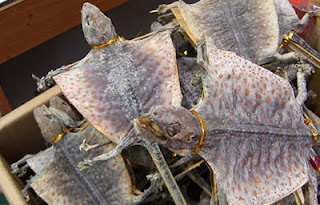
Have no fear: eating lizard won’t leave you cold-blooded. Take away the heads, and the lizard on a stick served at Wangfujing Night Market could pass as a bourgeoisie fan that matches your in-vogue snake-skin patterned boots. The flying bat-like position provides easy access for munching on the deep-fried, fishy-chicken flavor with a slightly pungent undertone. The head is a little daunting to swallow, but any feelings of stress are balanced by its supposedly blood pressure-reducing properties. The lizard's ability to remain motionless for hours on end has led some to believe that it can even cure insomnia. Overall, the taste isn't bad, but it isn't great either. The dry, crunchy meat and brittle bones have little taste. Lizard on a stick looks pretty cool, and it might impress or disgust your date, but it isn't going to do anything for your taste buds.
Find it: Wangfujing Night Market (Just northwest of the south entrance of Wangfujing Pedestrian Street)

Bone Marrow
Fear Factor: 2/3
Taste Factor: 3/5

Although one expects bone to be a solid and strong structure, inside is the highly nutritious spongy and fatty bone marrow, which is rich in lipids, proteins, vitamins and minerals. Try it at Manchurian Special Flavor Jiaozi Restaurant, where freshly stewed bones are accompanied by a plastic glove and straw (¥15 per bone). You push your straw into the bone and suck in the snot-like gooeyness just as though the pig bone were a juice box. Light in taste with a fatty, bland flavor, bone marrow was important in the diet of earlier civilizations. Some even hypothesize that its nutritional components contributed to the evolution of man’s larger brain. If sucking bone juice doesn’t seem like your thing, the succulent and aromatic meat surrounding the bone will surely please any carnivore. And if you’re still hungry, the Manchurian restaurant also serves up jellyfish salad, "nausea sauce pork" and "Grandpa’s big face sato."
Find it: Manchurian Special Flavor Jiaozi Restaurant (Dongzhimenwai Dajie, A-1 Xinzhongjie, 东直门外大街, 新中街A-1, Tel: 6415-2855)

Dog Hot Pot
Fear Factor:5/5
Taste Factor: 3/5
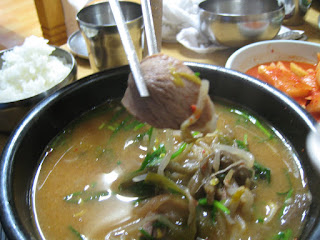
There is probably no Chinese dish that draws Westerners' ire more than dog meat. Dogs are supposed to be man's best friend rather than
man's best entrée, right? Two millennia ago in the
Middle Kingdom, however, dog was one of the three domesticated meats, which also included goat and pig. In the south, as well as in the northeast, it's still a popular delicacy. It was even served to Chinese astronauts during China's first space mission in 2003. Unable to go to space, we tried the dog hot pot (¥91) at Miao Village House, which carries an extensive menu of dog meats. The broth was a fragrant, sumptious mix of cloves, lemongrass and ginger—along with about four fistfuls of salt. Beneath the soup’s perfumed plumes of steam, unnervingly fatty slices of dog meat floated here and there. The meat had the consistency of overcooked, over-gravied baked steak. When mingled with the mashed potatoes, it tasted even more like Grandma's home cooking. Every thin slice of meat had a strip of drab, military green-colored skin stuck to it, which was a bit unnerving. The dog, the waitress told us, comes from a very small dog breed brought from Guizhou. Seeing that we were a little uncomfortable, she reassured us that this style of dog was a famous Guizhou dish and that many people come here to eat dog hot pot during the colder months. As it's winter and new legislation to ban dog meat in China is now on the table, now is the perfect time for breaking the Western taboo on dog meat—just don't be surprised if your friends swear to never speak to you again afterwards.
Find it: Miao Village House (4/F, 138 Wangfujing Dajie, 王府井大街138号4楼, Tel: 6523-8018)

Stinky Tofu
Fear Factor: 5/5
Taste Factor: 5/5
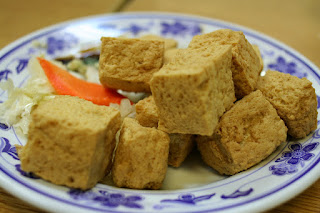
Everyone knows of the notorious stinky tofu that fills streets across China with a distinctly manure-like odor. Few, however, have actually tried it.
Fortunate are those who follow their noses. This famous delicacy originates in Shaoxing, where soybeans are left to ferment in a witches’ brew of brine for months before they are deep-fried to golden perfection and served with sweet and spicy sauce. On the outside, it reeks. On the inside, it’s all fragrant goodness. Brace yourself and head over to Houhai's (in)famous hole-in-the-wall Tianxia Diyi Chou ("Stinkiest in the World"), which has tormented and titillated for years. Once you bite into it, stinky tofu (¥5) is challenging and rewarding. Don’t turn your nose up at this one.
Find it: Tianxia Diyi Chou (77 Yan Dai Xie Jie, 77烟袋斜街)

By Michael Engstrom, Ola Kowalewski, Mia Li, Mikala Reasbeck, Blake Stone-Banks, Alex Taggart, Joanna Wong

Share/Bookmark

24 May, 2010

The Trouble With Teens
By Jiang Xueqin


There’s an old joke that goes like this: seven Chinese walk into a room, and ten political parties come out. Everyone says that Chinese are terrible managers, and an ordinary Chinese office will have more political drama than Romance of the Three Kingdoms and the Clinton household combined. Western managers know that Chinese have issues co-operating, and have spent tens of millions of dollars in corporate training to attempt to rectify this issue. But unlike the problem of process, co-operation is much harder to instil in Chinese because of a fundamental failing in China’s high schools.

Consider the life of an American high school student. He may play on a sports team, participate in student council, volunteer, date, and work part-time at McDonald’s. School can be a popularity contest, a jungle, a prison or just a nuisance, depending on your social designation. Teachers and parents, meanwhile, have resigned themselves to their minimal influence over these stubborn and rebellious teenagers, and will just seek to prevent pregnancies and drug abuse. The teenage years are an endless drama: fights with parents over curfew, acne, not making the football team or cheerleading squad, break-ups, depression, anorexia, Waiting for Godot anxiety, the prom.

Now consider the life of a Chinese teenager. He’ll study at his boarding school, and study when he’s locked at home on the weekends. His parents’ apartment and a classroom that looks like a prison cell are the boundaries of his experience and imagination. Chinese parents see their only child as a vessel for their aspirations and retirement plan; teachers see their students as test scores and possible financial rewards. The meaning and purpose of life are clear and simple: study hard, get a high score on the national examination, and become a mid-level bureaucrat.

Parents may not like the American teenager’s rebelliousness, and teachers may not like his lack of focus, but psychologists will explain that for the teenager his most important task is to construct a self-narrative that will become the basis of his identity, and permit him to engage the world as an independent human being. He ceases to yearn for the approval of his parents and teachers, and instead seeks the approval of his peers. He takes unnecessary risks (betting he could eat 10 hamburgers at once) and places himself in constant danger (actually trying to eat 10 hamburgers at once). He has exhilarating triumphs (getting a date with a cheerleader) and abysmal tragedies (the cheerleader cancels). He faces impossible obstacles (his mother) and deadly challenges (calculus class). He will seek allies (he’ll read The Fountainhead) and seek the meaning of life (he’ll re-read The Fountainhead). His memory takes all this epic drama from his teenage years and writes his very own Aeneid (so please excuse him if his memory doesn’t have room to store the periodic table, and only gets a B+ in chemistry).

Yes, in the process of formulating his identity, the teenager may be a selfish jerk, but the same process equips him with ‘empathy’ and the growing self-awareness that he is a selfish jerk.

By placing himself in different roles in different situations (a student, an employee, a friend, a collaborator, a lover) the teenager is exploring and pushing the boundaries and limits of the world, and developing the social consciousness and skills necessary to navigate this world. He discovers he can’t make the world conform to his worldview (his employer is really going to fire him if he’s late again, and his girlfriend is really going to dump him if he doesn’t stop hitting on her best friend), and so compromises and slowly learns to adjust his worldview to conform with the world. Pain and consequences force him to reflect on his self-centred stubborn ways. As slowly but as surely as a glacier, he learns to accept the validity and legitimacy of other viewpoints: his thinking will often become nuanced and tolerant, more open and welcoming of diversity and difference. And he stops recommending The Fountainhead and Atlas Shrugged to all his friends.

This symbiotic development of identity and empathy are what educators call the ‘socialization’process: a teenager’s passionate and vehement search for identity will be calmed and rounded-out by the development of empathy, which will allow him to enter society as a citizen and to co-operate with others.

The crucial first step in this process is that teenagers be permitted to take risks and make mistakes, be stubborn and unreasonable, and just be the anti-social misfits that they naturally are. But Chinese families and schools don’t permit even make-up and dating, let alone risks and dangers, triumphs and tragedies, obstacles and challenges.

Boys and girls are not permitted to be near one meter of each other on school grounds, there’s a regulation haircut and school uniform, and there’s no mobile phone service and Internet access. All the students dress, look, act and think the same, and an administrator’s greatest pride is to see his 1000 students do calisthenics in synch on the soccer field. Walls and gates limit the movement of students, security cameras and the eyes of teachers track students, and if it were possible administrators would implant a signalling device on each student. If all this is still not enough to depress and stress out the Chinese teenager, then the head teacher and/or parent will now and then remind him that he’s worthless and useless.

The result of all this unreasonable and unnecessary repression is that Chinese students are remarkably polite and well-behaved. But at the end of their schooling they won’t be able to write their own Aeneid, (thoughmaybe the more literary among them can write The Tale of Peter Rabbit). They will matriculate at a top university, but they will lack sympathy and empathy, which will hinder them from developing and managing personal and professional relationships; they won’t understand trust and tolerance, only power and fear. They may rise to a top management position, but lacking in self-understanding and self-reflection they’ll curse and criticize their subordinates, making the workplace a cold stagnant repressive regime.

Having skipped the tumultuous teenage years, Chinese are forever doomed to live as teenagers all their lives. Whereas Americans may be stubborn, moody, quick to anger, insecure, impetuous, condescending, extreme, and paranoid in their teenage years, Chinese may suffer from these psychological issues all their lives. The psychologists who wrote Reviving Ophelia, Raising Cain, and Real Boys may not be happy with how American families and schools are distorting the emotional development of children, but if they came to China they’d faint inhorror and despair.

In education, permitting high school students the space and time to develop their individuality so that they may learn empathy and become happy and healthy citizens is the highest and more urgent priority. This is common sense among American educators, but in China, thinking along these lines—that students have the right to develop as human beings, and that this process is long, painful, traumatic, and ultimately necessary for everyone’s good—requires a visionary reformer.

In September 2008, I was fortunate enough to be hired by arguably China’s one and only visionary reformer in education, Principal Wang Zheng of Shenzhen Middle School. When I arrived at the school’s large sprawling campus I couldn’t possibly suspect that for the past six years the tree-lined quiet campus was actually the site of a long, traumatic, intensifying battle for the soul and destiny of China’s youth.

Next I’d like to discuss Principal Wang Zheng’s reforms and efforts to turn his students into citizens, and the opposition to his education project.

Share/Bookmark

16 November, 2008

China, ¿Cerca de la perfección?


La reforma y la apertura de mercados de 1978 ha cambiado profundamente al país, pero, políticamente, el Partido Comunista no suelta la rienda. EL TIEMPO visitó el 'gigante asiático'.

A China le quedan 20 años para que su sistema de economía de mercado sea "perfecto". Al menos eso es lo que proclaman los funcionarios de más alto nivel hacia abajo, en el convencimiento de que el timonazo que dio en 1978 el líder Den Xiao Ping fue clave, no solo para mejorar el nivel de vida de sus más de 1.300 millones de habitantes, sino para proyectar al país como la potencia del milenio. O, como dicen ellos, "el más grande país en vía de desarrollo".

Un sistema que desafía a la más ortodoxa teoría del marxismo-leninismo y que defienden como un 'comunismo made in China'. Allí existe mercado abierto, propiedad privada, repartición de ingresos según el trabajo, consumismo y, en suma, capitalismo. Los chinos dejaron de usar el tradicional uniforme caqui, gris o azul (zhongshan) de la época de Mao Zedong, para remplazarlo, por ejemplo, por costosos Armani o prendas Zara. Todo, según sus ingresos.

Esa 'perfección' está en "liberar las razones humanas. Es decir, suplir la necesidad materialista social, en el sentido de que es más importante la necesidad espiritual", dijo a EL TIEMPO y a otros medios latinoamericanos Zhang Lina, subdirectora del Departamento de Reforma del Sistema, que forma parte del Comité de Desarrollo y Reformas de China.

No extraña, por eso, que en la calle Xiushui de Pekín se haya instalado el tradicional mercado de la seda (silk street), que no es más que una descomunal venta de artículos de exclusivas marcas... falsificadas, en el que no regatear es casi un insulto y en el que los turistas llegan en buses y gastan dinero a manos llenas. "Si te piden 1.000 yuanes, ofrece 300", aconsejó una turista española cargada de paquetes, mientras se probaba un collar de supuesta piedra jade.

Pero si en lo económico hubo apertura y reforma liberal, en lo político, el Gobierno y el Partido Comunista siguen manejando con pulso de hierro las riendas del sistema, una ortodoxia que conlleva dificultades en derechos humanos, trato a las minorías étnicas, libertad de expresión, de disentimiento y demás, al menos desde la óptica del ideal de las democracias occidentales.

'Hemos pasado de un sistema cerrado a uno abierto'

"Nuestro país ha experimentado un cambio profundo. Hemos convertido el sistema económico, basado en el modelo de la Unión Soviética, al actual sistema de economía social en el que el mercado juega un rol en la distribución de recursos. Hemos pasado de un sistema cerrado a uno abierto en todos los aspectos. La estructura social ha cambiado", dice Zhang.

Las cifras del cambio son aplastantes. La funcionaria repite de memoria que desde que arrancó la apertura y la reforma de Den, en 1978, la urbanización subió del 17 al 40 por ciento actual; la cantidad de pobres se redujo de 250 a 15 millones; la expectativa de vida aumentó de 68 a 73 años; el ingreso de la población se ha sextuplicado en la ciudad y en el campo, y otros datos descomunales que ponen de presente que la propiedad e iniciativa estatal se pueden mezclar con éxito con la economía de mercado.

La funcionaria no explicó si en la proyección a 50 años estaba que, por ejemplo, Pekín remplazará los viejos barrios por amplias avenidas repletas de autos que arrinconan a los ciclistas, o que la 'locura' de rascacielos de Shanghái la llevará a disputar el honor de ser el 'corazón financiero' de Asia. Lo que sí dejó en claro es que la prosperidad que se evidencia, y que aspiran a que llegue a más habitantes, especialmente rurales, fue disciplinadamente planeada y se debe a la continuidad de las políticas. Algo que, en los devaneos de la democracia occidental, quizás no se hubiera conseguido en apenas 30 años.

"Aprendimos que la práctica está primero que la teoría y debe dirigirla. Que los desarrollos económico y social deben ir de la mano, y que las reformas hay que hacerlas paso a paso, de lo fácil a lo difícil, del campo a la ciudad, diferentes tipos y grados de apertura, y no una reforma radical que quiera solucionarlo todo en breves plazos", reiteró Zhang.

No obstante, hay una sombra que inquieta: la crisis financiera mundial. Los más damnificados han sido sus principales mercados, es decir, Estados Unidos y Europa. Con la globalización, si el mundo baja su consumo, China siente el remezón.

Así lo reconoció el vicecanciller Li Jinzhang: "La crisis va a producir impactos negativos en China, pero estos son limitados y se pueden controlar. Si se tiene en cuenta el gran tamaño de la economía china, nuestra estabilización es un aporte a la salud de la economía mundial".

Sin embargo, el panorama se complica. Del magnífico 11,4 por ciento de crecimiento en el 2007, se podría caer al 8,5 que pronostica el Fondo Monetario Internacional para el 2009. A septiembre de este año había crecido 9,9. La subida de la producción industrial ha sido la más débil en siete años, la inversión extranjera también ha perdido vigor y las exportaciones e importaciones se han desacelerado.

El impacto de la crisis financiera mundial en China es "peor de lo previsto", admitió el jueves el primer ministro Wen Jiabao, cuatro días después del lanzamiento de un plan masivo de estímulo económico de 586 mil millones de dólares que serán invertidos en proyectos de impulso al consumo interno para compensar la caída de la demanda de los países desarrollados.

A pesar de esas cifras envidiables, a China le urge crecer a más del 8 por ciento, según los analistas. De lo contrario, sus proyecciones para los años que vienen, y para el 2028, cuando cumpla 50 años el proyecto de Deng, podrían sufrir serios tropiezos.

En el país hay confianza. Por eso, compran aviones a Brasil, beben vino chileno y cerveza Corona mexicana, pues quieren fomentar el consumo de productos con "valor agregado".

Pero del café colombiano quizás no hablar. El té chino, en todas sus formas, colores y sabores, difícilmente dejará de ser el rey.


Informe por EDUARD SOTO Por invitación del gobierno de la República Popular China
Fotos por Andres Vargas


Share/Bookmark

16 October, 2008

Países emergentes serían salvación a la crisis, mientras crece temor por recesión


Viernes 17 de Octubre de 2008
Portafolio con AFP


Una mujer pasa frente a las cifras desplegadas en un monitor, que equivalen a las operaciones del índice Hang Seng, de Hong Kong. Economías como la de china y otros países podrían asumir el papel de potencia económica mundial de E.U. (Foto: AFP)

China y Brasil, por ejemplo, se perfilan como los únicos capaces de dar empuje a la economía mundial, tomando el relevo de E.U., cuyo poder económico ha declinado, señalan analistas en Londres.

La ola de optimismo que hizo respirar brevemente a los mercados tras los masivos rescates financieros lanzados en Estados Unidos, Gran Bretaña y los países de la Eurozona, no duró mucho, y las bolsas volvieron a desplomarse el jueves, por temores a una recesión económica global.

El pánico ante una recesión en la mayor economía del mundo - que expertos predicen caerá entre uno o dos por ciento en el 2009, arrastrando la economía global - ha golpeado también a países emergentes como Brasil, cuya moneda, el real cayó más de 3,2% el miércoles.

La moneda de Brasil - que pertenece al exclusivo grupo de mercados emergentes denominado BRIC, que incluye también a Rusia y China -, ha perdido más de una cuarta parte de su valor desde comienzos de agosto, en cuanto que otros emergentes, como Ucrania, anunció el miércoles que pedirá ayuda al Fondo Monetario Internacional (FMI).

En este panorama de pánico e incertidumbre, pocos se atreven a mostrar optimismo, limitándose a esperar que la salvación para la economía mundial vendrá de las naciones emergentes, y en particular, de China, cuyo crecimiento ronda un 10% anual.

"El crecimiento de China ofrece la mejor esperanza para limitar el daño causado a la economía global por la actual crisis", señaló Vanessa Rossi, del departamento de Economía Internacional en el centro de análisis Chatham House, basado en Londres.

Según la experta, los países emergentes, liderados por China, probablemente seguirán creciendo, y pueden incluso "llegar a dominar el ciclo económico mundial".

Las economías emergentes son "lo suficientemente grandes y lo suficientemente vinculadas entre sí, y exitosas al promover políticas para favorecer el crecimiento, que lograrán sostener su propio crecimiento, en un contexto de recesión en Estados Unidos y los otros países desarrollados".

Señaló por ejemplo que los exportadores asiáticos que han volteado su mirada de Estados Unidos hacia China han sido los menos golpeados por la caída de las importaciones en la primera economía del mundo.

Jim O'Neill, economista en jefe de Goldman Sachs, asegura que Brasil, Rusia, India y China serán los motores para salir de la crisis. "Los BRIC podrían mostrar la salida a la crisis", dijo el experto, que fue quien agrupó bajo el acróstico BRIC a esos cuatro países.

Según él, "el consumo en los países BRIC será capaz de compensar la desaceleración en Estados Unidos". Una "gran parte de la demanda continua siendo creada en el seno de los BRIC, espercialmente en China", subrayó.

El desplazamiento del poder económico a China tiene también que ver con que ese país, tras la crisis financiera asiática, en 1997, amasó reservas en divisas que ahora son las mayores del mundo.

Y esas reservas siguen aumentando: a finales de septiembre, las reservas alcanzaron los 1,9056 billones de dólares, según cifras oficiales.

No es por casualidad que un país como Pakistán, que siempre se apoyó en Estados Unidos, no buscó ayuda esta vez en Washington, sino en Pekín, donde está ahora el dinero.

El Financial Times reportó el martes que el presidente paquistaní, Asif Ali Zardari, buscaría obtener de Pekín un préstamo preferente de entre 500 millones y 1.500 millones de dólares para superar la crisis financiera actual.

Y su pedido tuvo éxito: aunque Pekín no precisó el monto de esa ayuda, China se comprometió el jueves a ayudar a Islamabad a evitar el desastre financiero.

Con AFP
Share/Bookmark

26 September, 2007

A tribute to the 5:19


The 5:19 is probably the most friendly bar in Beijing. I had great times there and made lots of friends. This Bar is the house of the BEIJING HASH HOUSE HARRIERS and was the first bar I saw in Beijing! On my first day I went there to check out the very active night life of Beijing. unfortunately the 5:19 is on its final run. next saturday 29 will be the last night of the bar since the building will be used for other purposes.
To Dave "Brave Arse" McCullough (5:19 Owner), I would like to warmly thanks for all his efforts, for all his patient and for being such a good friend and hasher.
Now I would like to share with everyone a note made by the "China Daily" which can give you a better idea of what the 5:19 is.

Cheers for the 5:19, Cheers for Brave Arse!

On On

Andres "Dazed & Confused" Vargas

Home away from home
2007-06-08 China Daily

The 5:19 Bar claims to serve Beijing's best value-for-money Bloody Mary. It may also hold a title in the stakes of the city's friendliest watering hole. Tucked away at the end of Super Bar St, this homely tavern is the place to go when in need of respite from the neon scene of the other joints in this strip.

It has the lived-in feel of a local pub where all the patrons know one another. On the walls is para- phernalia relating to the various sporting associations for which 5:19 serves as base. All three chapters of Beijing's Hash House Harriers meet here (the owner co-chairs the Full Moon chapter) while it also hosts two expat dart teams.

We visit during the week and are immediately greeted by a jolly patron who has clearly been holding up the bar for quite some time.

"Cheers!" he says, raising a pint glass.

"Want to have a Kamikaze with us?"

This one sounds a bit lethal, being a school night and all, so we settle on a gin and tonic (15 yuan), which is finished with a wedge of lime. Other drinks are as reasonably priced, with local beer from 10 yuan a pint, Guinness for 15 yuan a pint, and Canadian Club whisky for 25 yuan.

At this relaxed place, punters can sit on stools at the bar, sink into well-worn sofas around a big screen, or take your poison outside to wicker chairs on the patio.

The vibe at 5:19 is as no-frills as its owner, an affable Canadian, Dave McCullough. A Beijing resident of ten years, McCullough opened this place in 2005.

"Basically, the philosophy was simple - a comfy, little pub like I used to go to back home," he says.

"A place where you can just go and be yourself, stripped off all the pretentiousness, where, you know, a drink is a drink. You can be yourself and let your hair down."

McCullough says he learnt to pour a drink in order to put himself through college, and now puts those skills to good use, mixing a mean Bloody Mary.

The secret is in the fresh lime and genuine Angostura bitters, while Worcestershire and Tabasco sauce, cayenne pepper and horseradish add a spicy kick.

Come on "Sunday Bloody Mary Sunday" and this tried-and-true hangover cure will set you back just 25 yuan (usually 30 yuan).

The 5:19 also serves Sunday brunch, including the meat-heavy Bloody Big Breakfast.

The pub's location in a square in sore need of rejuvenation means it lacks the crowds of Sanlitun.

The focus here is on regulars, while it has also become the after-work watering hole for a crew of American builders working on the new US Embassy, which will soon open nearby. Happy hour starts each evening at, you guessed it - 5:19pm.

Viva Goldner

8448-0896 26 Xingba Lu, Nuren Jie, next to PiliPili.

Message from Dave

Well, since everyone has been asking here is it. I tried and it didn't work. I just hope everyone liked what i tried to accomplish. I hope everyone felt a little better for the periods they were able to pop around. yeah I'd been struggling to keep things going for a while, and things had been picking up thanks to everyone's support. But in the end i just ran out of resources. But I loved almost every minute of it - yea i had my ad moments, and often i was pig headed, often i was over my head, often i had no clue how i was going to get through then next days bills but in the end well, the place doesn't matter. I met all of you. Thanks. You guys are great. I couldn't have found a better group of friends.

Anyways, the next few days are not about me but just trying to end things off at the bar for everyone involved. I want to make sure tht between now and Sunday i can make enough to pay the staff what i owe them because they've worked their asses off helping me and they deserve it.

I want to also pay off the booze guy cause he brought the product and deserves to be paid. I want to pay off the electricity and the other bills cause my landlord doesn't deserve to be stuck with them. And I want to pay back as much as possible to my landlord that i owe him before we close down. Had been very good to me over the last almost 2 years and deserves it.

And finally i just like to say goodbye to the place that i tried my best to make work and just couldn't quite get it there.And to spend the next few days around as many of you as possible because you have given me so much, you have taught me so much and i don't ever think i can enough time say thank you to you all for all you've given me.

I love you guys.

Dave McCullough

Closing Event

Well - all good things must come to an end. The landlord is selling the building and since I cant afford it I have to close down (Barring a Miracle on 34th street kind of thing). So it's time to close things down with our usual lack of Dignity - WITH A 24 HOUR FAREWELL PARTY!!!

Come down and drink heavily, share tales, DRINK HEAVILY, a few surprises and help me at least close down without owing anything at the end of it all. AND MOST IMPORTANTLY Allow me to thank everyone who who has supported The 5:19 and before that Artifacts Cafe over the last few years.

AGAIN THANKS EVERYONE and I look forward to sharing the final drink with you on Saturday.

Dave

The 5:19 Bar & Grill's Wake
Last chance to say goodbye to The 5:19

Time and PlaceStart Time:
Saturday, September 29, 2007 at 12:00pm
End Time:
Sunday, September 30, 2007 at 12:00pm
Location:
The 5:19 Bar & Grill
Street:
26 Xingba Road, Niurenjie, Chaoyang District
City/Town:
Beijing

Contact Info:
Tel. 84480896
Email:
FiveNineteen.Beijing@gmail.com


Share/Bookmark

23 May, 2007

La Comida del Grillo!


Creanlo o no... tenia cuenta en "youtube" pero nuca la alimentaba pa nada... esta vez me monte un videito... Mi primer videito y no el ultimo! Gracias a la cámara de mi amigo Cesar (que aparece en el mismo) en la populosa calle de Wanfujing, en Beijing, China. Deleitándonos con los delicatessen chinos! Editado pa' todo mi publico querido! Musicalizado por Dario Gomez!


Share/Bookmark

24 April, 2007

La Foto China


Sección dedicada a esos "No te la creo" "Es mentiras, caspa", esas cosas de ver para creer... Pa' publicar aunque sea una al mes!


Volvemos a los dormilones en China! Que bueno se duerme aqui! Sin problemas!
Aunque esta forma de dormir es mucho mas comoda que la que puse alguna vez no deja de ser una joya del buen dormir!


Share/Bookmark

22 January, 2007


NUEVO DESTINO DE VIAJE
New Trip Destiny


Vacaciones! que bueno es escuchar esa palabra! en especial cuando uno piensa que va estar con los amigos, que la familiy, el paseo de olla, que pa San Jerónimo a coger color... en fin... que rico es pensar en eso. Lo raro es que esta vez mis vacaciones son bien bien diferentes.

Para empezar comenzaron el 25 de enero... pa esos días esta uno empezando pero la universidad! Siguiendo, aquí las vacaciones son depresivas! en esta universidad están espantando! todos mis amigos se fueron pa sus países o un par de semanas pa otras ciudades en China. la amigovia se fue a visitar su familia a Mongolia y yo me he sabido quedar completamente solo en mi universidad. Pero bueno, no se si que es lo que se enfoca darle vueltas a mi mundo y aparecio una de mis alumnas invitándome a pasar vacaciones de invierno con su familia a la región mas alejada de todo china y también una de las mas interesantes... me voy pa' Xinjiang!

La región autónoma uigur de Xinjiang es un lugar de convergencia de las cuatro civilizaciones de Oriente y Occidente, así como un pueblo de cuentos. Xinjiang se conoce también como un pueblo de canto y danza, frutas, piedras preciosas y alfombras. Es una tierra misteriosa adonde anhelan ir los turistas nacionales y extranjeros. Situada en el corazón de Eurasia, la región reúne las culturas orientales y occidentales y tiene sitios de vestigio histórico en todas partes. Su fama se debe no solo por ser una de las partes mas importantes de la famosa ruta de la seda sino tambien por los hábitos y costumbres variopintos de los uigures, kazakos, kirguizos, uzbekos, xibes y mongoles. Sus dotes de paisaje natural son superiores, incluyendo páramos, oasis, gobis, praderas, nevados, lagos, glaciares y varios rios.

En Xinjiang el panorama natural es insólito y agreste: hay picos nevados junto a tierras calientes, y gobis junto a oasis. Xinjiang mide 1.660.000 km cuadrados de superficie, una sexta parte del total nacional, y es la región administrativa a nivel provincial más extensa del país.

Como detallitos del viajes les cuento que me voy via ferrea (puro trensito) durante 3 días... nada del otro mundo, ya lo hice antes cuando estaba en la india... pero 3 días en tren sentado! mejor dicho no se como la voy a hacer pero eso se convirtió en un reto mas para mi!
Tengo el tickete de ida mas no de venida... pensaba quedarme de 10 a 15 días (como mis amigos) pero resulta que no me venden si estando allá, ademas el festival de primavera empieza el 17 de febrero (y no es que sea primavera... alla voy a estar como a -20 grados), mejor dicho... regreso aquí a Beijing un mes después justo antes de empezar clases!


Esta aventura abarca algunos de los lugares mas importantes de Xinjiang, pero mas que todo eso me interesa es conocer como vive la gente, grata oportunidad para mi que voy a estar con una familia de campesinos nativos! mejor dicho a volver tocar la tierra! esto va ser un mes de mucha reflexión, alejado de las ciudades y de la vida cosmopolita en Beijing. Los rascacielos van a cambiar por enormes montanas cubiertas de nieve, nubes de polucion citadina por el acogedor humo de una fogón de lena, bicicletas por bueyes, yaks y camellos, Extranjeros por grupos étnicos, Internet por... bueno eso no creo que vaya a tener por alla... en fin la cosa va a ser definitivamente otro mundo.

La linea amarilla es mi ruta

Share/Bookmark

Visita "EL TESTAMENTO DEL PAISA"
Un homenaje al folklore y las costumbres de Antioquia La Grande!El Testamento del Paisa, Un homenaje a la raza paisa!

THE WORLD TIMES
Click on the zone to get the exact time