


Beijing is famous for its strange foods. From scorpion to penis hot pot, CW taste tests it all and dares you to expand your palate. Here are fifteen palate adventures… if you dare. By City Weekend Beijing
Rabbit Head
Fear Factor: 5/5
Taste Factor: 5/5
 One of hundreds of delicious snacks to come out of Chengdu, rabbit head takes pride of place on the menu at Shuangliu Laoma Tutou, arguably Beijing’s best Sichuan restaurant. The heads (¥8 per head) arrive skinned, with eyes, teeth and brain intact. It is cooked in either a five-spice or mala sauce. To get the maximum amount of meat, diners separate the rabbit’s upper and lower jawbones, bite out the tongue, gnaw away the cheek meat, crack open the skull and suck out the brains, being sure to vacuum up any excess meat along the way. While those not fond of bones in their food should probably sit this one out, we found that the interesting textures of the tongue and brains complement the tasty tenderness of the flavorsome cheek meat to make a dish whose only fault is its size—each rabbit head is only as big as a tennis ball.
Find it: Shuangliu Laoma Tutou (48 Third East Ring South Road, 48号东三环南路, Tel: 6540-5858)
Silkworm Cocoon
Fear Factor: 3/5
Taste Factor: 1/5
 Even when deep fried, the bulbous head of a silkworm cocoon threatens to hatch something nefarious and wiggly. We hunted down this Yunnan delicacy down at Chuan’r Bar, which specializes in skewering everything from bovine heart valves (¥3) to whole chicken heads (¥4). The silkworm chrysalis here (¥3) thankfully comes with a generous layer of cumin and chili, masking its true taste. Despite rumors of a “nutty” flavor, the spongy interior of our cocoons tasted like a shoe insole smells. More disgusting is the texture, which was very close to what a shoe insole feels like. Brave or inebriated diners can fortify themselves with the knowledge that silkworm cocoons are said to have powerful anti-aging properties. The faint of heart or sober can cheer from the sidelines with a tasty hot pot of skewers and a solid selection of veggie kebabs.
Find it: Chuan'r Bar (5–3 Dongzhimen Neidajie, 东城区东直门内大街5-3号, Tel: 6303-5678)
Fish Head
Fear Factor: 2/5
Taste Factor: 4/5
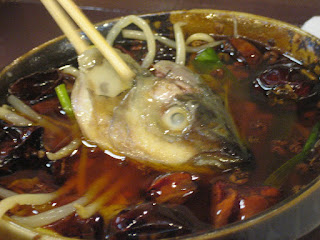 Sichuan restaurant Yu Xin serves some of the best steamed fish heads (¥58) in town. A classic Chinese dish, the steamed head of each yongyu carp is cut in half, then both halves are served cheek-side up on top of a bed of chili peppers and hot oil. The white eyes, believed to improve vision, are popular with diners and contain lots of healthy omega-3 fatty acids. Chinese diners will often fight over who gets to eat the eyes. The fish face, however, is the star of the show, as it contains the creamiest meat of the fish, the texture of which often resembles cream cheese. The small fish brain, a ball of transparent Jello-like substance connected to the eyes, has a very fishy odor and melts in the mouth. And yes, some believe it will make you smarter. Perhaps that's why in Chinese culture, the fish head should always be served so that it faces the most distinguished dinner guest.
Find it: Yu Xin (1/F, Jingtai Bldg, 24 Jianguomen Waidajie, 建国门外大街24号京泰大厦1层, Tel: 6515-6588)
Penis and Testes
Fear Factor: 5/5
Taste Factor: 1/5
 According to Traditional Chinese Medicine (TCM), eating a specific animal organ will improve the health of that organ within you. If this is ever proven, Guolizhuang, aka Beijing's "penis restaurant," will become even more crowded with middle-aged men than it already is. Guolizhuang serves penis, and lots of it: dog penis, horse penis, donkey penis, ram penis, deer penis ... Snake penis is rumored to make men particularly virile as snakes have two penises, allowing copulation with two partners at once. We suggest the penis hotpot (¥988), which includes all the penises mentioned above. The hotpot broth is served with an entire turtle in it, which, according to TCM, produces longer lasting erections. The actual meat, lean and jerky like, has almost no flavor. Its presentation, however, makes it much more exciting to eat than Viagra. All seating is in private rooms, so call ahead for reservations.
Find it: Guoli Zhuang (Dongsishitiao B34-3, 东四十条乙34-3号, Tel: 6405-5698)
Weird Wines
Fear Factor: 3/5
Taste Factor: 4/5
 Though China amuses tourists with snakes, animal penises and geckoes floating in bottles of everclear alcohol, only one of this nation's strange brews has a taste worthy of its oddness: Fermented mare's milk (¥45). A Mongolian alcohol made from fermenting and then distilling horse milk, the elixir tastes like a sweetened baijiu with a creamsicle aftertaste.
Though it may sound disgusting, most expats we've drunk it with have enjoyed the taste and even bought bottles of their own. We suggest picking some up at the Menggubao Chaoshi across from Little Sheep Hot Pot on Ghost Street. The Inner Mongolian foods store serves other Mongolian delights, including a range of spiced jerkies.
The fermented mare's milk is served in a yurt-shaped bottle, which also makes for a nice gift.
Find it: Caoyuan Xuri (158 Dongzhimennei Dajie, 东直门内大街158号, Tel: 8404-8518)
Spinal Chord
Fear Factor: 5/5
Taste Factor: 1/5
 Ghost Street is crowded with hot pot restaurants specializing in a classic delicacy: sheep's spinal cord hot pot. One of the best is found on a small alley just east of Dongzhimennei Beixiaojie. The Huayang Jinxing Sheep Spinal Cord Hot Pot Restaurant is full of baijiu fumes and red-faced diners gorging on the dish, which is literally called "sheep scorpion" (羊蝎子) because the spinal cord looks like the poisonous insect. Anything cooked with a bone tends toward savory and hearty, and sheep spinal cord is no exception. The meat itself tasted somewhat like ribs fresh off the bone, but the texture and size of the spine itself was daunting. After you pick off the meat, bite into the spine's soft tissue and cartilage. Suck in the marrow for extra credit.
Find it: Huayang Jinxing Sheep Spinal Cord Hot Pot Restaurant (North side of Beidongxiang, east of Traktir), 东直门北小街路口北东巷内 (近北新桥派出所, Tel: 8406-0609)
Pig Brains
Fear Factor: 5/5
Taste Factor: 1/5
 Kong Liang is one of Ghost Street’s most renowned hot pot restaurants, and regularly pulls in a large crowd of foreigners and Chinese, although its excellent reputation no doubt comes in spite of its pig brain dish rather than because of it. While ancient Chinese literature warns against eating brains (particularly for men), modern nutritionists claim they contains more calcium, phosphorous and iron than regular pork. Kong Liang serves a trio of raw pig brains (¥14), ready to be broiled in a mala hot pot (from ¥36) and dipped in satay sauce. Luckily, the mouth-numbing broth does a good job of covering the slightly rotten meaty taste of the brains, although it is powerless against the disagreeably squishy texture, which is likely to appeal only to fans of equally sludgy "tofu brains." There’s a saying in Chinese that says “eating brains helps the brain,” but we certainly didn’t feel any smarter after eating this.
Find it: Kongliang Chongqing Hotpot (218 Dongzhimen Neidajie, 东直门内大街218号, Tel: 8404-4906)
Scorpions and Beetles
Fear Factor: 5/5
Taste Factor: 2/5
 Though crawling live scorpions and long-horned beetles will not catalyze a rush of digestive enzymes into your stomach, a good deep-frying will sedate your desire to run away. After that it’s all or nothing: close your eyes and bite in. You'll find that, thankfully, any nuance of taste has disappeared. Both scorpion and beetle tastes like a good old fashioned potato chips with a little extra grease. Perhaps your next Halloween costume can be superhero “Venom-man” with eating scorpions as a party trick? Culturally, scorpions and beetles have a long history of being ingredients in magical concoctions that treat everything from epilepsy, rheumatism, tetanus and cancer. But be wary: one vendor teased that the large scorpion variety is imported from the United States, while another reassured that they are indeed a local delicacy. Regardless, one is still left to question the medical righteousness of these bizarre skewered creatures.
Find it: Wangfujing Night Market (Just northwest of the south entrance of Wangfujing Pedestrian Street)
Pig’s Feet
Fear Factor: 2/5
Taste Factor: 3/5
 A lively painting of a drooling, rabid-looking pig adorns the doorway of the “Duck Intestine Restaurant,” advertising its most popular dish: pig’s feet. Although the chef swears his trotters are cooked according to a home recipe from Yunnan, the flavors (honey roasted, hot and spicy and sour lemon sauce) bear a suspicious resemblance to pub-style chicken wings. Trotter pork is embraced by a thick blanket of fat and best eaten by biting confidently into the gelatinous flesh around the knuckles. In TCM, pig’s feet are said to beautify the skin and to help women with recovery after giving birth. We got our glow on by pairing our plate of trotters (¥36) with some braised cow feet (¥38) for virility.
Find it: Duck Intestine Restaurant (Yachang Hutong, 252 Dongzhimen Neidajie, 鸭肠胡同, 东城区东直门内大街252号, Tel: 158-1083-2956)
Ma Doufu
Fear Factor: 3/5
Taste Factor: 5/5
 The first time we ate the quintessential Beijing snack ma doufu, we weren’t sure what we were digging ourselves into. It looked like chunky hummus and tasted like rotten blue cheese—but we kind of like rotten cheese. When a faint-of-heart friend nauseously told us we had ingested mashed fermented soy beans stir-fried in mutton oil topped with dried chilis, we were neither shocked nor regretful. However, when we learned that ma doufu is the filtered residue left in the creation of douzhi, an incredibly gross lao Beijing dish if you ask us, we did have second thoughts. Like most fermented foods, ma doufu is healthy, strange and polemical. Get full on a warm plate at the cozy courtyard restaurant Liu Zhai Shifu for a mere ¥15 and decide for yourself. While you’re there, take your nose to its limits with China’s answer to wasabi: jiemodun (¥8), cabbage marinated in a whole-grain mustard so potent we cried just looking at it.
Find it: Liu Zhai Shifu (Meishuguan Dong Jie, 8 Jiang Jia Dayuan Hutong, 美术馆东街, 8蒋家大院胡同, Tel: 6400-5912)
Duck Blood
Fear Factor: 3/5
Taste Factor: 5/5
 Hua's Restaurant (Huajia Yiyuan) is a favorite among expats for its sublime Beijing duck and gorgeous courtyard. But those willing to explore the menu more deeply will find a few exciting, odd Chinese delicacies among the restaurant's expat-friendly Chinese classics. We recommend the maoxuewang (¥48), literally "bubbling blood," which is served in a large bowl of mala broth and a range of animal organs, including cow stomach and pig intestine. The duck blood itself is very pleasant, with a soft tofu texture and salty flavor vaguely reminiscent of black pudding, its bloody Western cousin. The small, dark, congealed cuboids of duck blood are high in red blood cells, iron and various amino acids that the human body is unable to synthesize on its own. It's perfect for the adventurous and the anaemic. The spicy red soup may be a little overpowering, but a cool glass of plum juice swiftly put the fires out. In celebration of our "Weird Food" cover story, Hua's Restaurant is giving away a specially prepared weird meal for two, including "beef tripe and duck blood in spicy sauce," "marinated chicken claws with pickles," "sauteed whelk with green beans," "Hua's Chinese cabbage" and two glasses of plum herbal tea. Click on "Win Stuff" at www.cityweekend.com.cn and enter before November 10 for your chance to win.
Find it: Hua's Restaurant (235 Dongzhimennei Dajie, 东直门内235号, Tel: 5128-3315)
Lizard
Fear Factor: 3/5
Taste Factor: 2/5
 Have no fear: eating lizard won’t leave you cold-blooded. Take away the heads, and the lizard on a stick served at Wangfujing Night Market could pass as a bourgeoisie fan that matches your in-vogue snake-skin patterned boots. The flying bat-like position provides easy access for munching on the deep-fried, fishy-chicken flavor with a slightly pungent undertone. The head is a little daunting to swallow, but any feelings of stress are balanced by its supposedly blood pressure-reducing properties. The lizard's ability to remain motionless for hours on end has led some to believe that it can even cure insomnia. Overall, the taste isn't bad, but it isn't great either. The dry, crunchy meat and brittle bones have little taste. Lizard on a stick looks pretty cool, and it might impress or disgust your date, but it isn't going to do anything for your taste buds.
Find it: Wangfujing Night Market (Just northwest of the south entrance of Wangfujing Pedestrian Street)
Bone Marrow
Fear Factor: 2/3
Taste Factor: 3/5
 Although one expects bone to be a solid and strong structure, inside is the highly nutritious spongy and fatty bone marrow, which is rich in lipids, proteins, vitamins and minerals. Try it at Manchurian Special Flavor Jiaozi Restaurant, where freshly stewed bones are accompanied by a plastic glove and straw (¥15 per bone). You push your straw into the bone and suck in the snot-like gooeyness just as though the pig bone were a juice box. Light in taste with a fatty, bland flavor, bone marrow was important in the diet of earlier civilizations. Some even hypothesize that its nutritional components contributed to the evolution of man’s larger brain. If sucking bone juice doesn’t seem like your thing, the succulent and aromatic meat surrounding the bone will surely please any carnivore. And if you’re still hungry, the Manchurian restaurant also serves up jellyfish salad, "nausea sauce pork" and "Grandpa’s big face sato."
Find it: Manchurian Special Flavor Jiaozi Restaurant (Dongzhimenwai Dajie, A-1 Xinzhongjie, 东直门外大街, 新中街A-1, Tel: 6415-2855)
Dog Hot Pot
Fear Factor:5/5
Taste Factor: 3/5
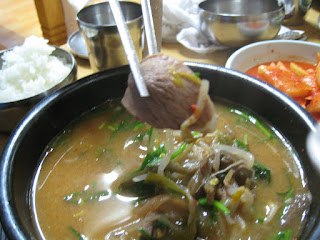 There is probably no Chinese dish that draws Westerners' ire more than dog meat. Dogs are supposed to be man's best friend rather than
 man's best entrée, right? Two millennia ago in the
Middle Kingdom, however, dog was one of the three domesticated meats, which also included goat and pig. In the south, as well as in the northeast, it's still a popular delicacy. It was even served to Chinese astronauts during China's first space mission in 2003. Unable to go to space, we tried the dog hot pot (¥91) at Miao Village House, which carries an extensive menu of dog meats. The broth was a fragrant, sumptious mix of cloves, lemongrass and ginger—along with about four fistfuls of salt. Beneath the soup’s perfumed plumes of steam, unnervingly fatty slices of dog meat floated here and there. The meat had the consistency of overcooked, over-gravied baked steak. When mingled with the mashed potatoes, it tasted even more like Grandma's home cooking. Every thin slice of meat had a strip of drab, military green-colored skin stuck to it, which was a bit unnerving. The dog, the waitress told us, comes from a very small dog breed brought from Guizhou. Seeing that we were a little uncomfortable, she reassured us that this style of dog was a famous Guizhou dish and that many people come here to eat dog hot pot during the colder months. As it's winter and new legislation to ban dog meat in China is now on the table, now is the perfect time for breaking the Western taboo on dog meat—just don't be surprised if your friends swear to never speak to you again afterwards.
Find it: Miao Village House (4/F, 138 Wangfujing Dajie, 王府井大街138号4楼, Tel: 6523-8018)
Stinky Tofu
Fear Factor: 5/5
Taste Factor: 5/5
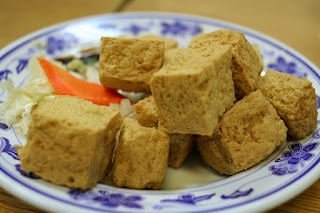 Everyone knows of the notorious stinky tofu that fills streets across China with a distinctly manure-like odor. Few, however, have actually tried it.
 Fortunate are those who follow their noses. This famous delicacy originates in Shaoxing, where soybeans are left to ferment in a witches’ brew of brine for months before they are deep-fried to golden perfection and served with sweet and spicy sauce. On the outside, it reeks. On the inside, it’s all fragrant goodness. Brace yourself and head over to Houhai's (in)famous hole-in-the-wall Tianxia Diyi Chou ("Stinkiest in the World"), which has tormented and titillated for years. Once you bite into it, stinky tofu (¥5) is challenging and rewarding. Don’t turn your nose up at this one.
Find it: Tianxia Diyi Chou (77 Yan Dai Xie Jie, 77烟袋斜街)

By Michael Engstrom, Ola Kowalewski, Mia Li, Mikala Reasbeck, Blake Stone-Banks, Alex Taggart, Joanna Wong





.png "English")


 Posts
Posts


